Donald Trump's Crazy Ivan
I don't think I've made clear that inflation is no longer a side effect. It's the entire plan. He said so himself.

The Crazy Ivan maneuver in popular culture generally involves a sudden and unexpected reversal of direction during a chase, facing the thing you are running from, then hitting the gas hard. It was first popularized in the movie The Hunt for Red October, but Wash from the Firefly series is the guy who made it look good.
Normally, when we think of fixing our monetary problems, we think of doing all that we can to maintain the value of the dollar. We run from inflation, as hard as we can without breaking things. Trump - as you might have guessed by now - has a different idea.
What if we lean into it? What if we purposefully devalue the dollar?
Wait, Why Are We Going Towards The Bad Thing?
Now, I need to write a number of disclaimers here: Is it possible to do this to some kind of positive effect? Yes. Is it worth the resulting inflation? No. Do I trust Donnyboy to inject just enough cash to stimulate the economy without destroying the dollar? No. This is why I use Bitcoin.
While I am basing this opinion on DJT’s own words and actions, it is still only an opinion, not financial advice. The new Fed Chair Kevin Warsh says he wants to maintain or raise rates and keep a stronger dollar. That said, I personally think he’s so full of fiat his eyeballs are swimming in it, and he’s just trying to keep the bond market in check.
OK, back to business. How can it sometimes be a “good thing” to devalue the dollar on purpose? Well, a strong dollar isn’t always such a great thing.
See, back in the 1980s, the world looked a little different. The dollar was incredibly strong against other currencies, most problematically the Japanese Yen. While this might sound like a non-problem, it was causing great issues in the export market.
If America is able to build a car for the same price as the Japanese were able to, but the dollar was too strong, the American car might be 1.5x the cost on the export market, because it would take more Yen to buy. This is to say that the exchange rate made American goods uncompetitive on the global market.
To solve this problem, the Treasury Secretary James Baker put together a secret meeting with the G5 nations. Without announcement or fanfare, the US, West Germany, Japan, France, and the United Kingdom quietly met in the Plaza Hotel in New York, and discussed what was to become the Plaza Accord of 1985.

Casually Changing the World in a Conference Room
In a secluded room of this quite opulent meeting place, the nations agreed that they would work together to devalue the dollar and strengthen the Yen. The Japanese, to show they were team players, agreed to strengthen the Yen by 10-20%, keeping the number low so they didn’t fall into the same trap as the Americans were trying to escape.
Now, that all sounds very abstract; numbers moving around, etc.. What it meant in reality was that it was decided - without a single vote or even the knowledge of the electorate - that the United States of America would devalue everybody’s savings and wages in order to boost exports. To accomplish this, the G5 nations worked together to flood the foreign exchange market with dollars, dumping them to make them just worthless enough.
Of course, there were positive effects on the economy for the US. Exports picked up as hoped, and the trade deficit was reduced substantially.
Hmm… there’s a phrase I hadn’t used yet: trade deficit. Reducing trade deficits just so happens to be one of Trump’s favorite subjects (which is why we have our tariff problem today). So is balancing trade the goal of the Crazy Ivan?
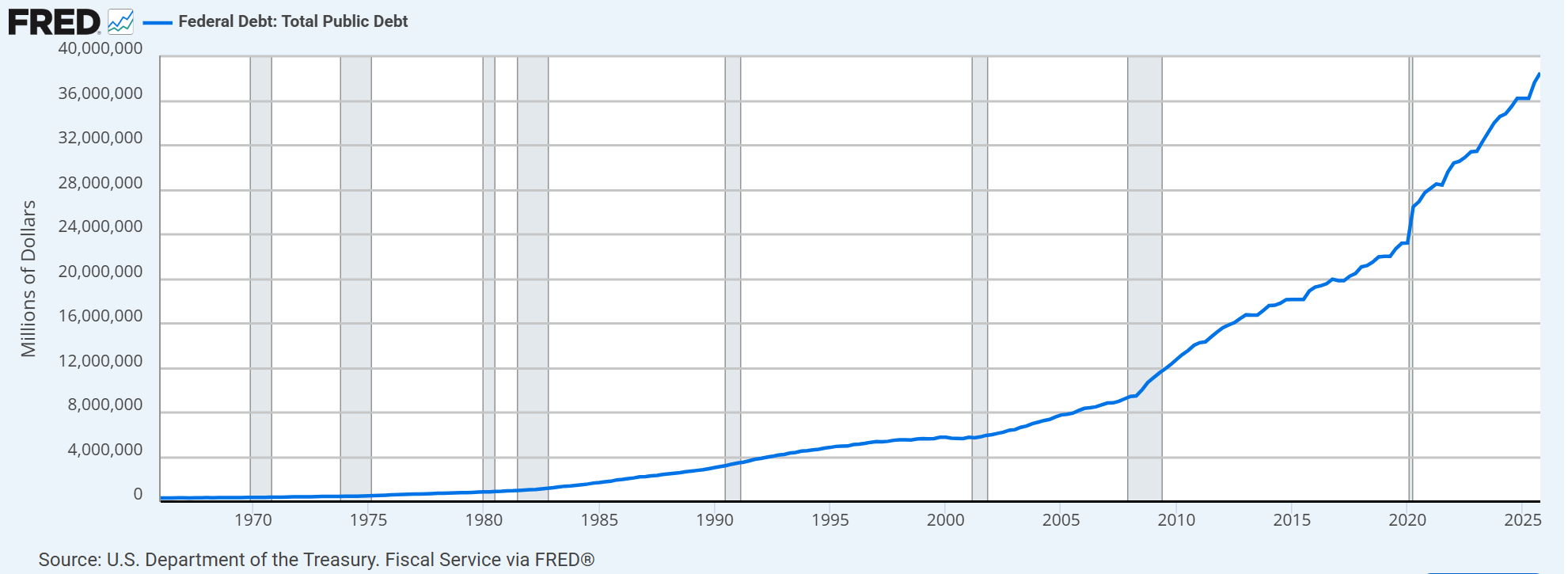
Actually, no. While the mechanics of what Trump wants to do will probably look a bit like the Plaza Accord, the goal is different. The goal this time is to make this debt insignificant.
Fiat Games
Imagine if you could set the scale of the price of things. You could double your wage but your costs also double, effectively halving the value of your money while maintaining the nominal value of any debt. You might quickly find a cheat code…
Make $100 a week, spend $50 a week on rent.
Make $100 the next week, spend $50 on rent.
Loan $400 from a bank, pay rent for two months
Inflate… you now make $400 a week.
First weekly paycheck, pay off the $400 loan.
You just paid two months of rent in one week.
This is the kind of bullshit that funny-money allows old men to pull, and this is now the goal with the national debt. If they print enough, the cost of maintaining that debt becomes smaller and smaller. Again, though, I will remind you: It doesn’t only devalue the debt, it also devalues your savings and wages.
In Trump’s own words: “We are becoming a country that is so rich, so powerful. With the kind of growth we have now, the debt is very low, relatively speaking. You grow yourself out of that debt.”
By “grow” he means stimulate growth through lower interest rates and liquidity injection. He talks about this a lot, even to the point that he was trying to blackmail the previous Fed chair to force him to lower rates and stimulate the economy.
And so this is the plan, such as it is. We will no longer run from a devalued dollar. We will undertake a 180 degree course change, fire up the engines with an injection of high octane liquidity, and burn hard towards inflation.
Buckle up, Buttercup. We’re going for a ride.
The Final Result
Oh, right… What was the real result of the Plaza Accord?
The Yen got stronger and stronger, far beyond their intended appreciation, and their export market fell. To combat this, they lowered interest rates drastically to devalue the currency. This easy money then went on to create an investment bubble which, when it collapsed in the 1990s, destroyed Japan’s economy for decades.
And the US Dollar - along with everybody’s savings - lost about 50% of its value over the next 10 years, exactly as planned.
The tangled web we weave…. Be excellent to each other, and don’t let them play games with the money you spent your life-hours earning.
That seems about right